
Overview
Loop: ~20 minutes • Era focus: 1800s–1940s • Tone: belief-neutral
tap to expand ▾
Overview
Loop: ~20 minutes • Era focus: 1800s–1940s • Tone: belief-neutral
Loop ~20m
Tone: belief-neutral
Era: 1800s–1940s
Kit: flashlight • 2 cones/LED • review QR
Start/End
Hotel Temecula, 42100 Main St.
Route order
Route snapshot
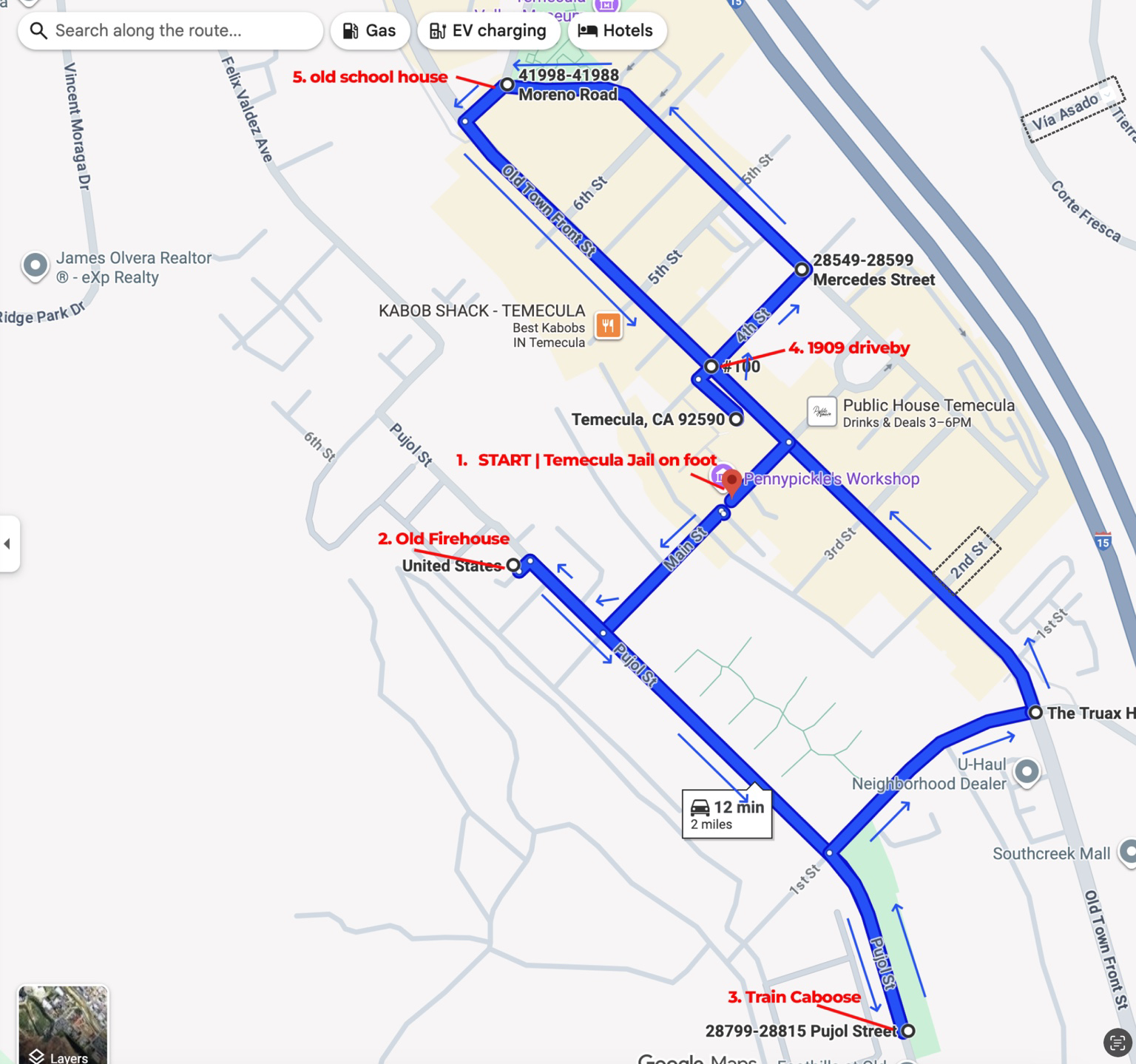
Tap to open full-size map. Addresses live inside each stop.
Route & Stops
Click to jump to section.
Hotel Temecula (Staging • Start/End)
tap to expand ▾
30‑second hook
“Welcome to the Hotel Temecula—one of the last places in Old Town where the floors remember your footsteps. Ranch hands, railroad men, and travelers slept here, swapping stories under kerosene light. By the end of tonight, you’ll have a few of your own.”
Quick facts
- The original hotel on this site served railroad travelers in the late 1880s–1890s. After an earlier structure was lost, a new hotel rose in 1891 and anchored the town’s hospitality trade for decades.
- The Welty family figured heavily in early Old Town businesses, including lodging and the post office.
Story beats
- Old Town boomed with the railroad’s arrival in the 1880s—suddenly you had a steady flow of ranchers, quarry crews, and officials. A place like this wasn’t luxury; it was heat in winter, shade in summer, and a bed that didn’t buck.
- Picture tin washbasins, boots drying by the stove, and the soft clink of coins at the bar after a long day on the range. The hotel became the unofficial lobby of Temecula—if you wanted news, you came here.
- Set expectation for the night: “We’ll walk and ride through the bones of the old town—jail, rail, school—and I’ll point out the spots where the stories stick.”
Ops & etiquette
- Remind guests about uneven surfaces/curbs.
- Photos welcome; please avoid shining lights into businesses or moving vehicles.
Stop 1 — The Jail (quick walk‑in from sidecars)
tap to expand ▾
30‑second hook
“Temecula’s first ‘lock‑up’ wasn’t a fortress—it was more like a stubborn little stone box. If the door didn’t keep you in, the stories did. The stone keeps a hard chill even in summer, and folks say voices carry oddly inside—like the walls hang onto sound. Picture a deputy with a key, a sheepish cowboy cooling off, and the town settling by midnight.”
Quick facts
- Early “jail” here functioned more like a holding cell/well house—sturdy walls, minimal comforts, and a long memory in local lore (late 19th/early 20th century).
- The town often relied on the nearest deputy or whoever could keep the peace until county authorities arrived.
Story beats
- Scene‑set: a Saturday night ruckus, two men jawing at The Stables, the deputy ending it with a long look and a shorter walk to this door.
- Frontier judgment vs county law; most disputes ended with dawn apologies and sore heads.
- Early Temecula wasn’t lawless—it was small. Everyone knew everyone, which made shame a stronger sentence than steel bars.
Ops & etiquette
- Keep voices low; quick in/out so we don’t crowd.
- Safety: watch the threshold.
Stop 2 — Old Firehouse Area / “Little Old Town” (28577 Pujol St)
tap to expand ▾
30‑second hook
“This corner reads like a family album—livery, homestead, well house, and the bones of a tiny service district that kept Old Town moving. The McConville place held a house and barn by 1882; the little stone wellhouse nearby earned a ‘jail’ nickname. Think of a micro‑grid: water for families, feed and shoes for wagons and horses, and a cot for anyone who over‑celebrated.”
Quick facts
- The modern ‘firehouse’ façade is later, but this block ties to earlier homestead/service uses—McConville house & barn (c.1882), livery, and a stout wellhouse.
- Across Old Town, the Machado family raised a permanent store in 1909 after the earlier Long Branch saloon/inn era ended in the 1880s disaster cycle.
Story beats
- Point to the work triangle: water, animals, tools—the maintenance heart of a frontier town.
- McConville name recurs in early police and ranch stories: practical folks who could mend a wheel, calm a horse, or cool a hothead.
- Contrast with the railroad: rails drew people in; this block kept them going day after day.
Ops & etiquette
- Stay off private thresholds; tell the story from safe pull‑out/parking.
Stop 3 — The Caboose (Railroad Story)
tap to expand ▾
30‑second hook
“Temecula was a railroad town by necessity—and for a few rough years, by sheer stubbornness. The California Southern pushed through the canyon in 1882, and Temecula thrummed. Then the winters of 1883–84 ripped the line apart—crews rebuilt, floods returned. By 1888 the coastal Surf Line siphoned traffic; a final washout in 1891 ended canyon service. The rails built this place up, and the river tried to take it back.”
Quick facts
- California Southern Railroad reached Temecula Canyon in 1882; townsite surveyed soon after.
- Repeated washouts 1883–84; service restored January 6, 1885.
- Surf Line (1888) diverted through traffic; 1891 washout ended canyon operations.
Story beats
- Soundscape: steam, brake squeal, whistle—granite, cattle, mail moving faster than ever.
- Flood imagery: trestles twisting like straw; feast (busy trains) vs famine (silent rails).
- Caboose as rolling office/bunk; a lantern swinging at night meant morning business in town.
Ops & etiquette
- Stay clear of traffic; quick photos by the caboose, then load up.
Front Street “Drive‑By” Lore (to Schoolhouse)
tap to expand ▾
Use this during slow rolls; stack short stories—one building, one bite‑sized tale.
Swing Inn
- Keep post‑1950 minimal. Long‑running café lineage; the coffee changes, the gossip doesn’t.
1909 Building / former livery & mercantile zone
- Ranch & rail gravity well—supplies in by train/wagon; cash out in leather wallets & IOUs.
The Bank (First National Bank of Temecula, 1914)
- Raised when ranch money needed a vault and a ledger, not a mattress; directors were ranchers & merchants.
- Lore angle: “Everybody’s armed, nobody’s dumb”—a robber here faced more than one barrel. Frame as local lore unless citing a specific case.
Long Branch / Machado Store (1909)
- After late‑1880s disaster cycle ended the wooden saloon/inn era, the Machado family built a sturdier store: merchandise downstairs, social life everywhere.
Stables & livery district
- Where tempers and tequila shook hands; Saturday‑night dustups cooled in the “jail” box till sunrise. If using the 1907 gun story, present it as a documented incident of that year; retellings vary.
Welty / Ramona Inn lineage
- c.1908 Joe Winkels’s Ramona Inn in a Welty structure: card tables, slots, even a boxing ring upstairs— a magnet for ranch hands and traveling promoters.
Stop 4 — Old Schoolhouse (Pujol School)
tap to expand ▾
30‑second hook
“Temecula taught its kids in a one‑room school—arithmetic by day, community by night. If the bell rang after dark, it meant a meeting, a dance, or trouble. Built in 1889 as the Pujol School, it followed the families as the town’s center of gravity shifted with rails, floods, and roads. One teacher, all grades, and a stove that kept lessons warm.”
Quick facts
- Built 1889 as the Pujol School, originally near the present museum area.
- The building moved multiple times as settlement patterns shifted; final relocation (1986) placed it on Santiago Road (post‑1950 mention kept brief).
Story beats
- Daily life: chalk dust, slate boards, winter stove, summer windows.
- Schools doubled as community halls—box socials, holiday recitals, flood meetings.
- Why it moved: the school followed the families as transportation routes changed.
Ops & etiquette
- If stepping out: mind traffic, quick photos, voices low if services or neighbors nearby.
Return to Hotel Temecula (Wrap & Photo)
tap to expand ▾
Wrap script
“Tonight you met a stubborn little town—built by rails and ranches, watered by a hard‑won well, taught in a one‑room school, and kept in line by neighbors who all knew your name. Thanks for walking it with us. Let’s grab two photos: one with the hotel behind you, one candid while you’re laughing—those are always the keepers.”
Suggested photos
- Guests on the boardwalk with hotel façade.
- Hands on the old banister or rail (detail shot).
- Looking down Front Street at twilight (lanterns/signs if lit).
Safety & contingencies
- Heat, curbs, traffic; offer water check‑in.
- If Front Street jams, add a bonus rail story while idling (use washout beats).
- If a stop is blocked, swap order: Caboose → Schoolhouse → Firehouse area → Drive‑by back to Hotel.
Optional add‑ons
- Two‑minute fiddle break near the end (clear with neighbors first).
- Vintage prop (train lantern) hand‑off for end photo.
One‑liners (padding)
- “If you hear Temecula said three different ways tonight, you’re doing it right.”
- “Canyon floods took the rails like a dealer scooping chips—gone in a blink.”
- “Bankers here knew the weight of a coin purse and the smell of a saddle blanket.”